You built for six months. Nobody came.
Not because the code was bad. Because the problem wasn’t validated before you wrote line one. Most developers know they should validate before building. What gets skipped is how — the specific questions to answer, the signals to look for, and the order that makes the research actually predictive.
Here’s the framework. Run it before your next project.
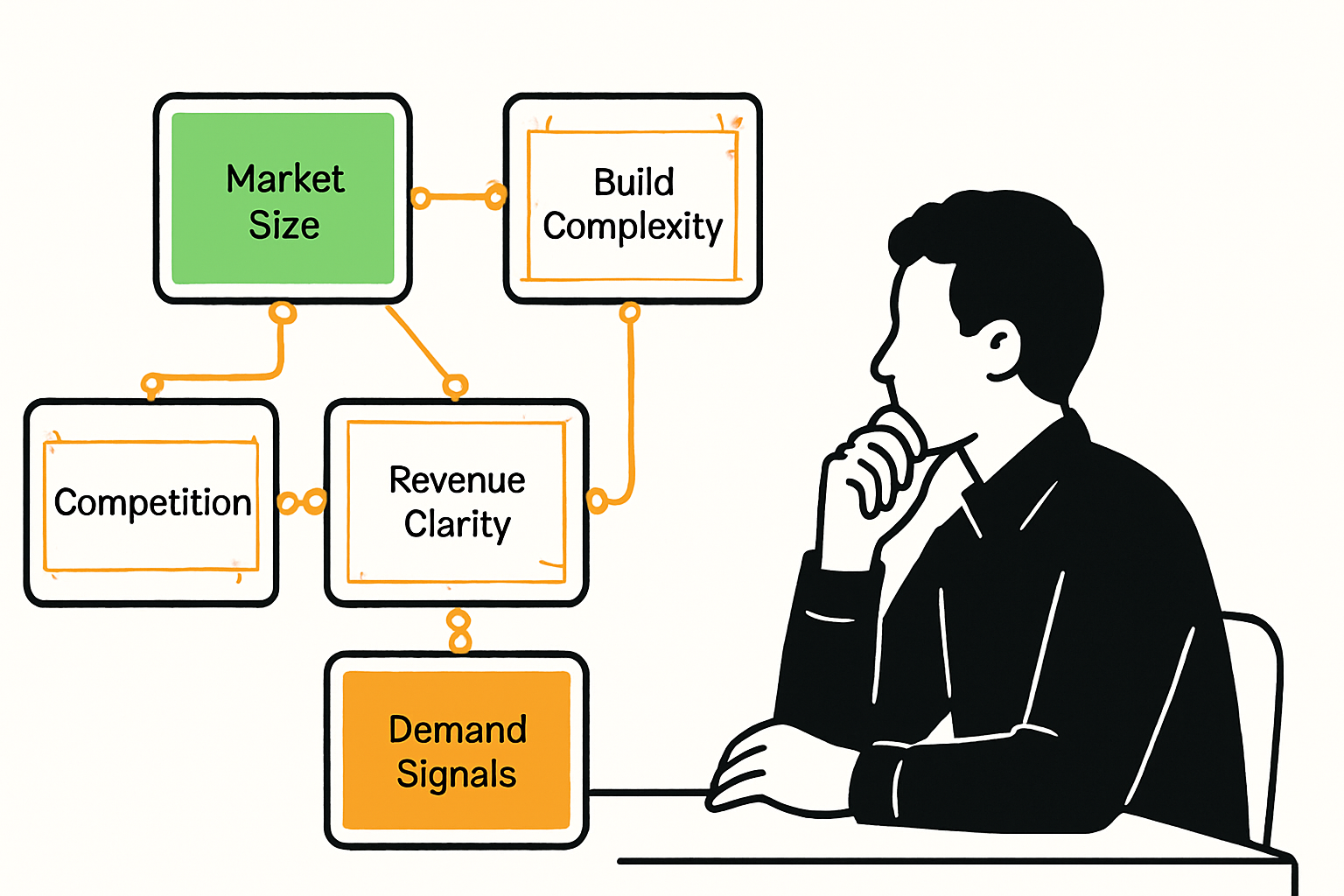
The 5-Dimension Framework for How to Validate a SaaS Idea
Before any code gets written, answer five questions. This is the same rubric ForgeDrops uses to score every business idea before packaging it into a drop.
1. Market Size — Is There Actually a Market Here?
Don’t pull TAM estimates from 2019 market research reports. Do the math yourself:
- How many businesses or individuals have this exact problem?
- What do they currently spend to solve it — tools, time, consultants, manual workarounds?
- What’s a realistic slice you could own in three years?
A $50M addressable market is workable. A “$40 billion global market” you can’t find 100 real buyers in is not.
2. Competition — Is There a Gap, or Are You Just Slower?
Competition confirms demand exists. The question is whether a genuine gap exists: an underserved segment, a workflow existing tools handle badly, or a customer too small or too specialized for incumbents to care about. If you can’t name the specific gap in 30 seconds, you haven’t found it yet.
3. Build Complexity — Can You Ship Something in 90 Days?
Not the full vision. An MVP that earns the first dollar. If your honest estimate starts at 12 months, either cut scope or move on. The product that ships at 70% and iterates beats the perfect product that never launches.
4. Revenue Clarity — Do You Know Exactly How You’ll Charge?
Subscription, usage-based, per-seat, one-time? The model shapes your acquisition strategy, unit economics, and early customer conversations. Vagueness here usually means the value prop isn’t sharp yet.
5. Demand Signals — Have You Seen It, Not Just Inferred It?
Reddit threads where people list every tool they’ve tried and explain why none of them work. Job postings asking for contractors to solve the problem manually. App Store reviews of competitors all complaining about the same missing feature. Not surveys — signals. Real humans expressing a real need in their own words.
The Validate SaaS Idea Trap: Interest Isn’t Demand
Most founder advice says “talk to customers.” That’s right but incomplete. The trap is mistaking polite interest for real demand.
“That sounds useful” is not demand. Someone paying for an inferior tool because no better option exists is demand. Someone building a workaround in Excel because they’ve given up finding a solution is demand. Someone posting in a forum asking whether this product exists is demand.
The fastest validation methods that actually work:
- Search demand: Check Google Keyword Planner or Ahrefs for the core problem search. If 10,000 people a month search “how to X,” someone will pay to skip that work.
- Community complaints: Find three Reddit or Discord threads where people list the tools they’ve tried and explain why they’re still unsatisfied. Read the exact words — they’re your future marketing copy.
- Willingness to pay: Find five people who fit your ICP and name a price. Not “would you pay for this?” — that question gets polite agreement. Say “this would be $79/month — does that work?” Watch what happens when a real number is on the table.
- Landing page test: Build a one-page description of the product (not the product) and run $100 of ads to your target keyword. A 5% email conversion from cold traffic is a strong signal. Under 1% means the message or the market needs rethinking.
SaaS Idea Validation Is a Loop, Not a Checkbox
The pre-build validation pass saves months of wasted development. But saas idea validation isn’t something you do once and cross off. The best founders treat it as a tightening loop:
- Validate the problem — Does this pain exist at scale, or is it a quirk of a small group?
- Validate the solution concept — Does your specific approach make sense to the people who have the pain?
- Validate pricing — Will they pay what you need to charge to build a real business?
- Validate acquisition — Can you actually reach these people affordably?
Each loop is cheaper than the next build sprint. Founders who skip the loop spend six months shipping to an audience that was never going to buy. Founders who run it twice before writing a line of code ship things people actually use.
Order matters too. Validate the problem before you validate the solution. Plenty of well-built products failed because the builders confirmed people liked their approach without checking whether people actually had the problem badly enough to pay for a fix.
If you’d rather start from ideas that have already passed through this filter, that’s what ForgeDrops is for. Every drop includes a viability score, market analysis, implementation guide, and code starters — see the drops →
What a Validated Business Idea Actually Looks Like
A few markers separate ideas worth building from ideas that just feel compelling:
- You can name three specific competitors and know exactly what each is missing for a specific customer segment
- Someone in a relevant community has asked “is there anything that does X specifically for Y type of business?”
- Consultants or agencies are charging hourly for what you want to automate — that’s proof the work happens and people pay for it
- The biggest player’s pricing starts at $500/month, and there’s an entire tier of customers who need 20% of the features at 20% of the price
- A keyword for the core problem gets 5,000+ monthly searches with low-competition content ranking for it
Check two or three of these and you have a real signal. If you’re rationalizing why none apply, the idea isn’t ready.
Test the Business Idea Before It Costs You Six Months
Validating a SaaS idea before building isn’t about proving certainty — it’s about making a better bet with the time you have. The five-dimension rubric gives you structured answers to questions most builders skip entirely. Run through it once before your next project and you’ll spend those months shipping something that earns instead of something that teaches you an expensive lesson.
ForgeDrops is for founders who want to skip to the part where the research is already done. Every drop includes the viability score, the market analysis, the implementation guide, and code starters for business ideas that have already passed the five-dimension filter.