There are more than four million solo tradespeople in the United States — plumbers, electricians, HVAC techs, and general contractors who run their entire business alone. They quote jobs, schedule work, order parts, invoice clients, and chase payments without a single employee. Almost all of them are doing it on a stack of four or five disconnected apps that were never designed for them.
That gap is the business. Here’s why the timing has never been better to build into it.
The Tool Stack That’s Bleeding Solo Trades Operators
Ask a solo electrician how they run their business and you’ll hear a version of the same story: Google Calendar for scheduling, a notes app or whiteboard for job details, QuickBooks or Wave for invoicing, Square for payments, and text messages for client communication. Maybe they’ve tried Jobber or Housecall Pro — but those tools are priced and designed for teams of five or more.
Jobber starts at $199/month and assumes you have a dispatcher and field techs. ServiceTitan is enterprise software built for franchises. Housecall Pro’s headline features — crew management, GPS fleet tracking, multi-technician dispatch — are completely useless when you’re the only person on every job. The solo operator ends up in one of two places: paying for a platform designed for someone else, or stitching together free tools that don’t talk to each other.
The pain shows up in two ways. First, admin time: solo tradespeople spend an estimated 15–20% of their working hours on business tasks — quoting, invoicing, chasing payments — instead of billable work. At $90/hour, that’s $14,000–$18,000 in annual lost revenue. Second, revenue leakage: without consistent follow-up, jobs get forgotten, invoices go unpaid, and repeat customers go to whoever happened to leave a flyer. One contractor I came across mentioned finding $12,000 in outstanding invoices he’d simply lost track of after moving off a whiteboard.
What the AI-Native Version of This Business Looks Like
The product opportunity isn’t “build a simpler Jobber.” The insight is that AI changes what a one-person software company can actually deliver to a market that historically required expensive, feature-bloated enterprise software to serve well.
Three capabilities carry most of the value in the 2026 version of this product:
Photo-to-quote generation. A solo plumber arrives at a job, takes three photos of the problem, and the app generates a professional quote in under 30 seconds — line items, labor estimate, and materials list drawn from their historical job data and current supplier pricing. Claude’s vision API can analyze a photo of a water heater, identify the model and likely failure mode, and draft a quote the tradesperson reviews and sends in one tap. For someone who currently spends 45 minutes writing quotes by hand, that’s worth $49/month on its own.
Voice-to-invoice after job completion. At the end of a job, the tradesperson dictates a 60-second voice note describing what they did. The app converts it to a structured invoice — service description, hours worked, materials used — and sends it automatically. No manual entry, no invoices forgotten because the tech was exhausted after a 10-hour day on a crawlspace repair.
Client follow-up on autopilot. The AI handles the follow-up sequence: a check-in message 48 hours after job completion, a seasonal service reminder six months out, a polite payment nudge for invoices past 14 days. The operator configures the cadence once; the system runs it without prompting. In trades, repeat business and referrals drive most revenue — systematic follow-up turns one-time calls into long-term client relationships without the operator thinking about it.
Why the Incumbents Aren’t Going to Fix This
Jobber and ServiceTitan are shipping AI features, but they’re bolting them onto architectures and pricing models built for multi-person field service operations. Their 2025 AI announcements were mostly “smart dispatch” and “AI scheduling assistants” — features that assume you have a dispatcher to assist and multiple techs to schedule.
Solo operators are a low priority in their roadmaps because solo operators have lower contract value than teams and higher support burden per dollar. That’s the opening. Build for the customer the big players actively deprioritize, go deep enough that data accumulation creates real switching costs, and you have a durable niche before the incumbents notice it’s worth their attention.
The real competitor isn’t Jobber. It’s inertia — the tradesperson who keeps using a whiteboard and a spreadsheet because switching tools feels like a weekend of lost work. That’s a product design problem, not a market problem. If onboarding takes under 20 minutes and the app imports their existing client list from phone contacts, the friction disappears before it becomes a reason to quit.
The Market Math
4.1 million non-employer trades businesses in the US (Census Bureau, 2024). Roughly 60% use at least one business app on their smartphone. That’s a serviceable addressable market of around 2.5 million operators.
At $49/month — below Jobber’s entry tier, well within what a $90/hour electrician spends on fuel in a week — you need 1,700 active customers to cross $1M ARR. At $79/month, it’s 1,050. These aren’t moonshot targets. They’re achievable by a solo founder in 18 months with focused distribution in the right communities.
Distribution in trades isn’t a mystery either. Tradespeople talk. They’re active in Facebook groups for local plumbers and electricians, on r/Plumbing and r/ContractorTalk, and in their supplier networks. A referral program that gives both parties a free month converts well in communities where trust travels through word of mouth. A co-marketing deal with a regional electrical supply house — “show this at checkout for a free trial” — puts you in front of exactly the right people at exactly the right moment.
Getting Your First 100 Customers
The fastest path into this market is a genuine product announcement in the communities where solo tradespeople already spend time — not advertising, a real post from a builder showing the before-and-after. A 60-second screen recording of a quote generated from a job photo converts better than any ad copy.
Local trade associations and supplier relationships matter from the start. Electrical supply houses and plumbing wholesalers have newsletters, bulletin boards, and sales reps who talk to solo operators every single day. These channels are underused by SaaS founders who default to Facebook ads — which means less competition for your attention there.
Design the referral mechanic on day one. A solo plumber who saves two hours a week on admin will tell other solo plumbers unprompted. When you make that referral earn them a free month, you have a distribution engine that costs deferred revenue instead of ad spend — and compounds faster in tight-knit trade communities than in almost any other vertical.
What You’re Actually Building
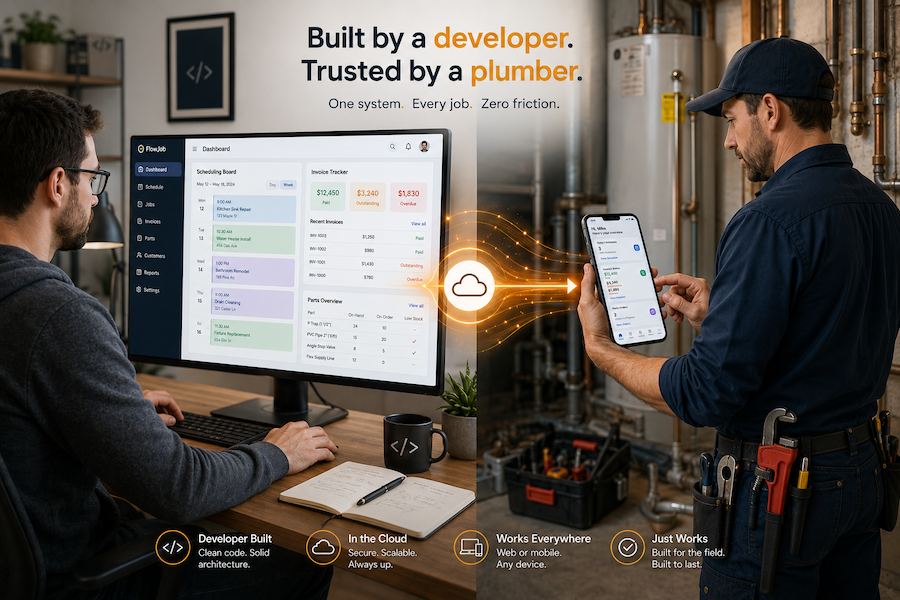
The core product is a Next.js web app — mobile-responsive, PWA-capable for use in the field — with five modules: client database, job management, quoting, invoicing, and payment collection via Stripe. The AI layer sits on top: Claude handles document generation from photos and voice notes, and the follow-up automation logic.
The MVP — quoting, invoicing, payment, and basic client management — is a 6–8 week build for a developer who’s worked with Stripe and an LLM API before. The AI features add 2–3 weeks. You’re not training a custom model. You’re building the application layer on top of Claude’s API with prompts that understand what a professional trades quote looks like.
Defensibility accumulates over time. After six months of use, the app knows a specific electrician’s labor rates, preferred suppliers, typical job types, and pricing patterns. That personalization makes the AI outputs meaningfully better than a generic tool — and makes switching away expensive in a way that pure feature parity can’t replicate.
Solo Tradesperson OS isn’t a new category. It’s an underserved segment of a large market, made viable for a one-person software company by AI capabilities that arrived in the last 18 months. The market is large, the pain is well-documented, the incumbents are focused elsewhere, and the build complexity is within reach of a solo developer. That combination doesn’t come along often.
Ready to skip the research? Get the full ForgeDrops package for Solo Tradesperson OS — depth doc, implementation guide, and code starters included.